March 2026
By: Josh Walejewski
Read Time: 3-4 Minutes
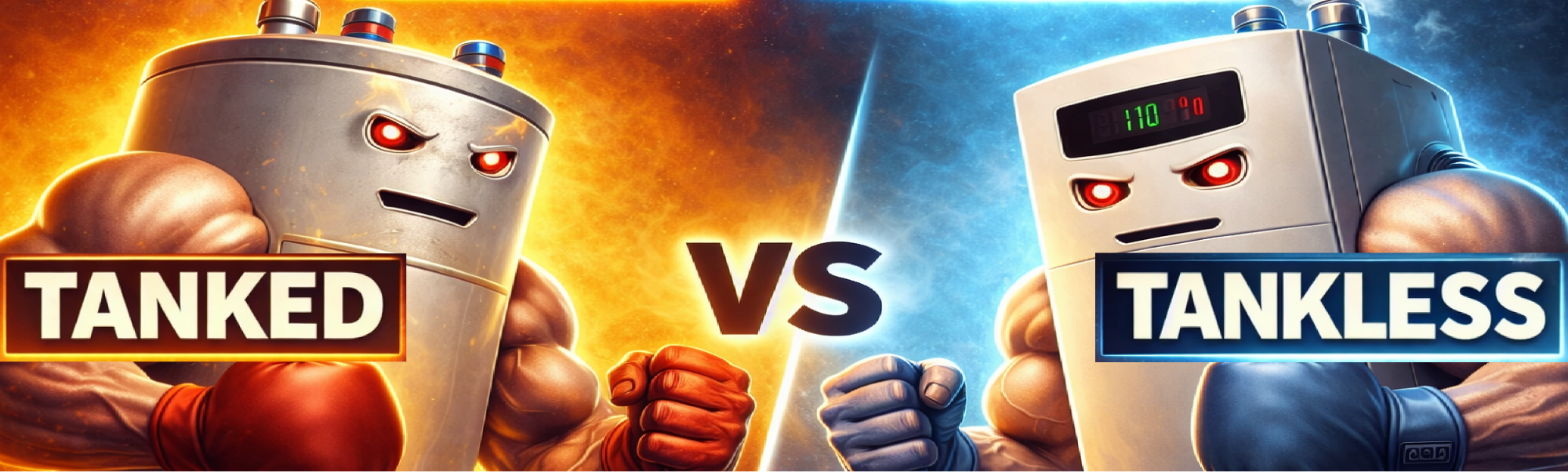
Ladies and gentlemen, welcome to the ultimate heavyweight showdown in home hot water! In one corner, we’ve got the tried-and-true crowd favorite: the Tanked Water Heater, famous for raw storage power and simple, reliable performance.
In the opposite corner, making a lot of noise lately, we’ve got the sleek contender: the Tankless Water Heater, known for its “hot water on demand” style and space-saving swagger.
Over the course of 11 rounds, these two plumbing titans will battle it out in categories like lifespan, installation cost, maintenance, energy use, and more. Each round is worth one point. At the end, we’ll tally the scorecards and crown a champion.
Before we ring the bell, let’s look at how each of these heavyweights’ fighting styles delivers hot water.
Tanked Water Heaters
Tanked systems fight like a classic heavyweight brawler. Think George Foreman. They store a big reserve of hot water and deliver a strong punch… until the tank taps out and needs recovery time to catch its breath.
Tankless Water Heaters
Tankless systems fight like a highly trained seasoned veteran. Akin to Muhammad Ali. They heat water as you use it, so they can keep throwing high-intensity punches even after 15 rounds. As long as you don’t ask them to supply four showers, a dishwasher, and laundry all at the same time, they are a very formidable opponent in the ring.
Now grab your ringside seat. Round one is about to start!
Round 1: Water Heater Lifespan
 In this opening round, we’re looking at how long each system can stay in the ring before needing a replacement.
Tanked Water Heaters typically last ~12 years (sometimes longer with great maintenance and friendly water conditions). They’re simple, but the tank itself is always under pressure, always holding water, and always aging.
Tankless Water Heaters often last 15–20+ years with proper care. They don’t store a giant vat of hot water, so the “big tank failure” problem goes away. You’re still maintaining a heat exchanger and its components, but the lifespan usually lasts longer.
🛎️ Winner of Round 1: Tankless Water Heaters
Tankless takes the first point with longer staying power.

Round 2: Water Heater Installation Cost
Round two focuses on the upfront investment costs.
Tanked Water Heaters are usually the lower-cost option to purchase and install. If you’re replacing like-for-like, the job is often straightforward.
Tankless Water Heaters typically cost more up front. Installation can require upgrades like larger gas lines, new venting, condensate drainage (for high-efficiency units), and sometimes electrical changes.
🛎️ Winner of Round 2: Tanked Water Heaters
Tanked wins on budget-friendliness out of the gate.
Round 3: Installation Complexity
This round is about how “plug-and-play” each contender is in a real home.
Tanked Water Heaters tend to be simpler to swap out, especially if you’re staying with the same fuel type, venting style, and a similar capacity.
Tankless Water Heaters can be a little pickier. The system might need venting changes, gas supply upgrades, and careful placement. It’s not “hard,” but it’s less forgiving.
🛎️ Winner of Round 3: Tanked Water Heaters
Tanked takes the round with the simpler install path in most homes.
Round 4: Maintenance and Upkeep Requirements
Round four is about what it takes to keep each one in peak fighting shape.
Tanked Water Heaters benefit from annual or bi-annual flushing to reduce sediment buildup and may need an anode rod check/replacement depending on water conditions. If you’ve got hard water (hello, Wisconsin), tanks can collect sediment faster.
Tankless Water Heaters should be descaled regularly, especially in hard-water areas. Skip that and performance can drop, parts can suffer, and you can shorten the life of the unit.
🛎️ Winner of Round 4: Tanked Water Heaters
Both need care, but tankless typically demands more consistent & mandatory maintenance.
Round 5: Maintenance Costs
Now we’re talking about the money side of upkeep.
Tanked Water Heaters usually have lower maintenance costs. When maintenance is done, it’s often simpler and quicker.
Tankless Water Heaters can cost more to maintain because descaling service is common, and water quality matters more. (Many homeowners also choose water softening or filtration to protect the unit.)
🛎️ Winner of Round 5: Tanked Water Heaters
Tanked wins on cheaper upkeep most of the time.
Round 6: Repair Costs
 In round six, we look at the cost of unexpected setbacks.
Tanked Water Heaters are generally cheaper to repair, but here’s the catch: once the tank itself fails, it’s usually replacement time.
Tankless Water Heaters can be more expensive to repair because the components are more advanced and diagnosis can be more involved. The upside is that repairs can make sense more often because the unit’s lifespan is longer.
🛎️ Winner of Round 6: Tanked Water Heaters
Lower repair costs and simpler parts give tanks the edge.
Round 7: Energy Use
This is the “what’s it cost to keep feeding this fighter?” round.
Tanked Water Heaters suffer from standby heat loss. Even if no one uses hot water, the tank keeps reheating to maintain the temperature.
Tankless Water Heaters heat only when you call for hot water. Less standby loss usually means better efficiency, especially for households with lighter or moderate usage.
🛎️ Winner of Round 7: Tankless Water Heaters
Tankless takes a much-needed round after a slow start with their lower energy waste and on-demand heating.
Round 8: Capacity for Busy Households & Peak Demand
Round eight is about simultaneous demand. How well can each unit handle scenarios like two people showing at once, while both the dishwasher and washing machine are running.
Tanked Water Heaters often handle “many things at once” well until the stored supply runs out. Bigger tanks can help, as can higher-recovery models.
Tankless Water Heaters need to be sized for peak demand. Some homes need a larger unit or even multiple units to keep up with heavy simultaneous use & peak demand.
🛎️ Winner of Round 8: Tanked Water Heaters
Tanked gets the point here because it can muscle through bursts of high demand without needing perfect sizing math.

Round 9: The Shower Marathon (Back-to-Back-to-Back Showers)
Now we’re looking at a different kind of busy: a household of 4 to 6 people taking back-to-back showers. No one’s showering, running the dishwasher, and doing laundry all at once. Just a line of people trying to get ready for their day without turning the last two into accidental popsicles.
Tanked Water Heaters can throw George Foreman-level haymakers of hot water; however, they don’t train cardio and get winded fast. Once the stored hot water is used up, the tanked water heater leans into the ropes hard, trying to catch its breath. Depending on the size of the tank, the first few showers might feel great… However, the latter ones may start to feel like a cold plunge nobody volunteered for.
Tankless Water Heaters were built for this round. They heat water on demand, so they can keep throwing heat round after round. Try to rope-a-dope it all you want—tankless doesn’t get tired the same way, because there’s no stored hot water to run out of. In a back-to-back shower marathon, the last person still gets a hot shower.
🛎️ Winner of Round 9: Tankless Water Heaters
When it comes to endurance, Tankless stays on its feet and keeps throwing the heat.
Round 10: Space and Placement
Round ten is about footprint (size) and flexibility.
Tanked Water Heaters take up real space. Basements usually have room, but tight utility areas can feel cramped. And let’s be real, we could all use some extra storage space.
Tankless Water Heaters mount on a wall and free up floor space. In smaller homes or finished basements, this is a big quality-of-life upgrade.
🛎️ Winner of Round 10: Tankless Water Heaters
Tankless wins with the space-saving advantage.
Round 11: “Oh No” Factor (Leaks, Damage, and Peace of Mind)
Final round. We’re talking risk and what happens when things go sideways.
Tanked Water Heaters store 40–75 gallons (or more) of water. If the tank fails, it can leak fast and cause damage. Many homeowners use leak detectors and drain pans for a reason.
Tankless Water Heaters don’t store a large volume of water, so the “tank dump” risk is reduced. They can still leak, but the potential damage is typically less dramatic.
🛎️ Winner of Round 11: Tankless Water Heaters
Less stored water means less “my basement is now a shallow pond” potential.
The Final Verdict
The judges have tallied the scores, and it’s time to announce the winner.
Tanked Water Heaters: Wins in Rounds 2, 3, 4, 5, 6, and 8. Total: 6 points
Tankless Water Heaters: Wins in Rounds 1, 7, 9, 10, and 11. Total: 5 points

🥇 The winner, by the slimmest margin, is the Tanked Water Heater!
“But wait,” says the crowd (and half of the internet gasps), “isn’t tankless supposed to win?”
Here’s the honest take: Tankless absolutely can be the better choice for the right household, especially if your family needs to take back-to-back-to-back showers in the morning, better efficiency, more space and plans on staying in the home for the full 20+ year lifespan of a tankless unit. But in the average home, the lower installation cost, simpler maintenance, and simpler repairs often keep tanked units winning on practicality.
Bottom line: Choose your water heater based on your home, not the hype.
- If you want lower upfront cost and simpler ownership: Team Tanked
- For endless hot water, space savings, and higher efficiency: Team Tankless (size it correctly and commit to maintenance)
Not sure which system fits your household’s needs? We can help you choose based on your home’s hot water demand, plumbing setup, and water conditions.
Want to stop guessing and get the right match-up for your house? Contact Kettle Moraine to schedule a water heater consult, maintenance visit, or book online.
Read more blog posts from Kettle Moraine Heating & AC.
About the Author
Josh Walejewski
Josh is a professional marketer who has worked in the HVAC industry since 2017. With a Bachelor of Applied Arts and Sciences Degree (B.A.A.S) in marketing and sustainable business management from the University of Wisconsin, he has a passion for all aspects of HVAC, business, marketing, and environmental stewardship.