


September 2026
By: Josh Walejewski
Read Time: 3-4 Minutes
Garages aren’t just places to park cars anymore. They’ve become workshops, home gyms, storage spaces, EV charging stations, hobby rooms, and, occasionally, the place where someone owns enough power tools to make the neighbors slightly nervous.
And as we ask our garages to do more, many homeowners eventually run into the same problem:
There isn’t enough convenient electrical power where they need it.
One solution may be installing an electrical subpanel in the garage.
A garage subpanel can make it easier to add circuits, power larger equipment, and prepare for electrical needs you haven’t even thought about yet. But whether installing one makes sense, and what installation looks like, can be very different for an attached garage versus a detached garage.
What Is an Electrical Subpanel?
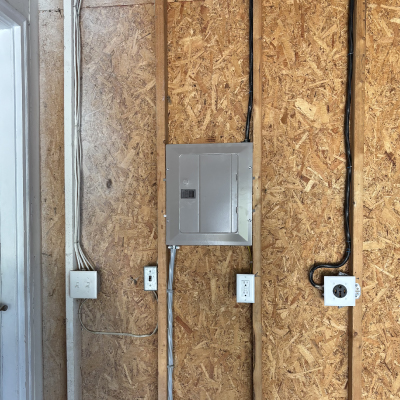 Think of the electrical panel in your home as the main distribution center for electricity.
A subpanel is a smaller distribution center connected to that main panel by a feeder. Instead of running every new garage circuit individually all the way back to the home’s main electrical panel, an electrician can run power to the garage subpanel and distribute individual circuits from there.
In other words:
One appropriately sized feeder can become the starting point for several garage circuits.
That can be especially useful if you expect your electrical needs to grow.
Benefit #1: More Room for Garage Circuits
This is probably the most obvious reason homeowners install a garage subpanel.
A garage may eventually need separate circuits for things like:
- Garage door openers
- Lighting
- General outlets
- A refrigerator or freezer
- Power tools
- An air compressor
- A welder
- An electric vehicle charger
- Electric heat
- A mini-split heating and cooling system
Trying to serve everything from one or two existing garage circuits can become limiting quickly.
A subpanel gives an electrician a central place to properly separate and organize those loads.
Benefit #2: It Makes Future Electrical Projects Easier
This may actually be the biggest benefit. Imagine that five years from now you decide to install an EV charger. Then two years later you buy a larger air compressor. Then somebody decides the garage needs heat because apparently scraping ice from the windshield every morning has finally become unacceptable.
Without a garage subpanel, each project may require another circuit to be routed all the way back to the home’s main electrical panel. With a properly planned subpanel already in the garage, much of the electrical infrastructure is already nearby. That can mean less wire, less disruption, and fewer finished walls or ceilings that need to be worked around during future projects.
It is essentially the electrical equivalent of running an empty conduit somewhere while the walls are already open. You may not know exactly what you’ll use it for yet, but future you will be quite happy it is there.
Benefit #3: Your Garage Becomes Much More Workshop-Friendly
If your idea of working in the garage involves plugging in a drill occasionally, your existing electrical system may be perfectly adequate. But serious workshops can be surprisingly power-hungry. Table saws, dust collectors, welders, compressors, lifts and other equipment can require dedicated circuits or 240-volt power.
A garage subpanel makes it much easier to design circuits around the equipment you actually use instead of depending heavily on extension cords, power strips, or whatever receptacle happens to be closest. It also gives you room to grow if your collection of tools mysteriously continues getting larger and larger. We’re told this inexplicable phenomenon happens quite often as homeowners age.
Benefit #4: Preparing for an EV Becomes Easier
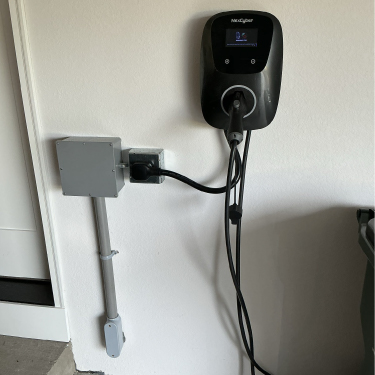
You don’t necessarily need to own an electric vehicle today for EV charging to be worth considering. Cars can stay in a household for years. Electrical infrastructure can stay there for decades. If you’re already doing major electrical work in a garage, it can make sense to ask what would be required to support an EV charger someday.
That doesn’t necessarily mean installing the charger now. It may simply mean choosing a feeder, panel location or electrical pathway with future EV charging in mind.
A little planning during today’s project can potentially avoid considerably more work later.
Benefit #5: Heating and Cooling the Garage Becomes More Practical
Wisconsin garages tend to have two temperature settings: Walk-in freezer and pizza oven. If you eventually want to install electric heat, a mini-split, ventilation equipment or other climate-control equipment, having adequate electrical capacity nearby can make those projects much easier.
This becomes particularly valuable for garages used as workshops, gyms or hobby spaces where people actually spend time rather than just sprinting between the house and car in January.
Benefit #6: It Can Support Things Outside the Garage, Too
This is one of the more overlooked possibilities.
Once substantial electrical infrastructure reaches the garage, the garage may become a useful starting point for future electrical projects around that portion of the property.
Depending on the home and the electrical design, that might include:
- Outdoor lighting
- Security cameras
- Driveway or landscape lighting
- Exterior receptacles
- Another accessory/outdoor building such as a shed, boathouse, or pool house
- Patio electrical needs
- Holiday lighting
- Gates or other powered equipment
This can be particularly useful with a detached garage located some distance from the house. Instead of treating the garage as the electrical finish line, it can sometimes become a convenient electrical starting point for other projects on that part of the property.
One important note: A subpanel doesn’t increase the total electrical capacity available to your home. Your electrician will still need to determine whether your existing service can support the garage loads you’re planning.
Installing a Subpanel in an Attached Garage
An attached garage is usually the simpler installation.
Because the garage is part of the same structure as the home, an electrician can often route the feeder from the home’s main electrical panel through accessible areas such as a basement, utility room, attic, ceiling cavity or wall.
A typical project may involve:
- Evaluating the home’s electrical service and anticipated garage loads.
- Determining an appropriate panel size and location.
- Routing a feeder from the main electrical panel to the garage.
- Installing the garage subpanel.
- Adding or relocating garage circuits as needed.
- Completing required permitting and inspection.
The difficulty can depend heavily on the home’s construction. An unfinished basement beneath or near the garage may provide an easy pathway. A finished home with drywall, ceilings, and limited access may require a more creative route. Because attached garages also require separation from the living portions of the home, electrical penetrations through those assemblies need to be handled appropriately.
So, while an attached garage avoids excavation or trenching, the pathway between the main panel and garage can still have a major influence on the project.
Installing a Subpanel in a Detached Garage
Detached garages are a different animal.
Now electricity must travel from one building to another.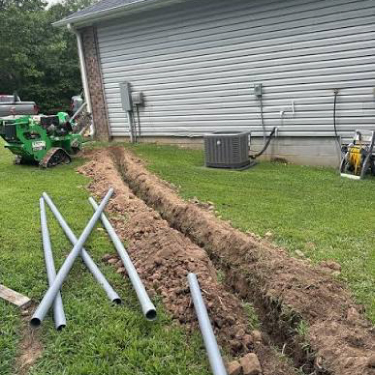
In many homes, that means installing a feeder underground between the house and garage, although the exact wiring method depends on the property and installation.
A detached-garage project might involve:
- Evaluating the home’s available electrical capacity.
- Determining how much power should be supplied to the garage.
- Planning a route between the house and garage.
- Locating underground utilities before excavation.
- Trenching between the buildings when underground wiring is used.
- Installing the required electrical wiring or conduit.
- Installing the garage panel and required disconnecting equipment.
- Installing the appropriate grounding system.
- Connecting individual garage circuits.
- Completing required inspections.
For detached garages, the distance between your home and garage matters.
A garage 15 feet from the house is a very different project from one sitting 150 feet away.
Longer distances can affect conductor sizing, voltage-drop considerations, trenching costs and the overall installation method.
Existing driveways, patios, landscaping and other obstacles can also influence the best route.
If You’re Trenching Anyway, Think About Tomorrow
Here’s another item homeowners frequently overlook. If excavation is required to bring power to a detached garage, this is a good time to think beyond the immediate electrical project. Are there other utilities or pathways you may want in the future?
- Natural Gas for garage heaters
- Internet?
- Water supply for a wash station
- Security cameras
- Another outbuilding
- Different electrical equipment
Not everything can share the same conduit, and separation requirements may apply, but discussing the future with your contractors before the trench gets filled back in can prevent the unpleasant realization that you need to dig up the same yard again three years later. A trench is much cheaper to think about while it’s still open.
Is a Garage Subpanel Worth Installing?
Not every garage needs one. If your garage has adequate lighting, plenty of outlets, and no foreseeable need for larger electrical equipment, installing a subpanel simply for the sake of having one probably doesn’t make sense.
But if you are constantly thinking: “Can I plug that in out here?” or “Could we add an EV charger someday?” or “I’d really like to turn this into a workshop…” Then it may be worth discussing.
The biggest benefit isn’t necessarily what a garage subpanel lets you install today. It’s how many options it can give you tomorrow.
A well-planned electrical system can turn the garage from a place with a couple of outlets into a flexible space capable of changing along with your home. Interested in exploring what a subpanel installation would cost for your home? Contact us.
Read more blog posts from Kettle Moraine Heating & AC.
About the Author
Josh Walejewski
Josh is a professional marketer who has worked in the HVAC industry since 2017. With a Bachelor of Applied Arts and Sciences Degree (B.A.A.S) in marketing and sustainable business management from the University of Wisconsin, he has a passion for all aspects of HVAC, business, marketing, and environmental stewardship.