
May 2026
By: Josh Walejewski
Read Time: 3-4 Minutes
If your basement smells musty every summer, feels damp no matter what you do, or has a portable dehumidifier running like it’s training for a marathon, you’re not alone. A store-bought portable dehumidifier can absolutely help in the right situation. For one damp room, a small storage area, or a short-term moisture problem, it may be enough to take the edge off.
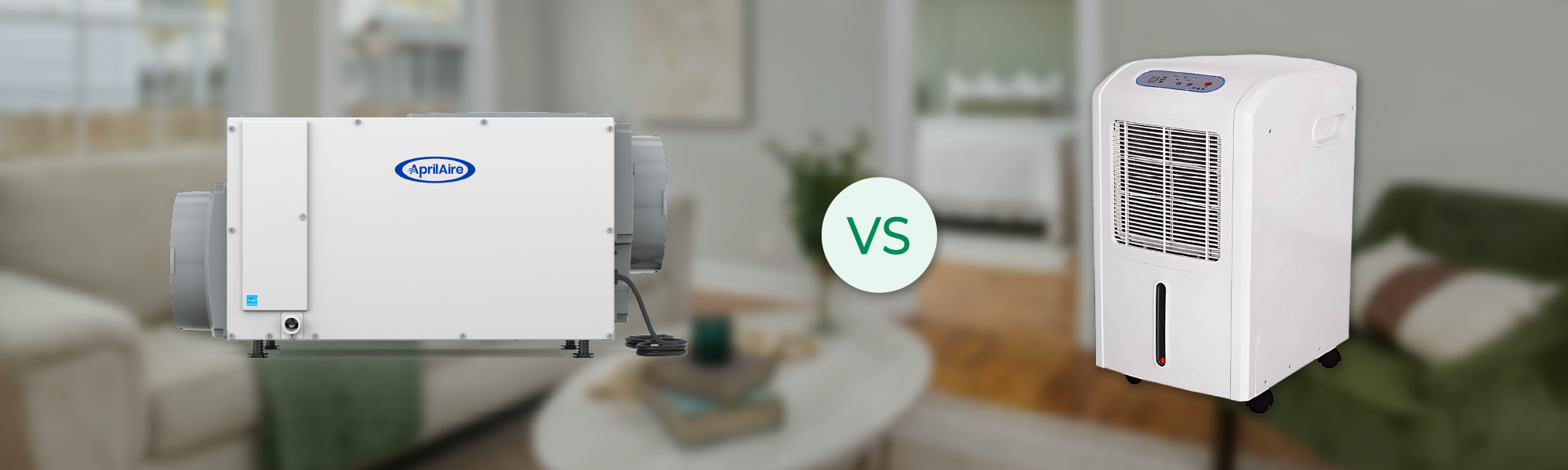
But here’s where things get confusing: some portable units advertise big numbers like 100, 120, or even 150 pints per day, while a professionally installed AprilAire whole-home dehumidifier may appear to have similar capacity ratings at first glance.
So why would someone pay more for a whole-home AprilAire system? Because the number on the box of a retail unit does not always tell the full story.
Portable Dehumidifier vs. Whole-Home Dehumidifier
The real difference comes down to:
- Real-world moisture removal
- Test conditions behind the advertised capacity rating
- Energy efficiency
- Convenience and long-term performance
- Lifespan
- Warranty coverage and peace of mind
- Proper placement for the home’s humidity problem
Let’s start with the biggest source of confusion: capacity rating for pints per day.
The Dehumidifier Rating Trap: Check the Spec Sheet
Most shoppers compare dehumidifiers by looking at the biggest number they can find. A 150-pint dehumidifier sounds stronger than a 100 pint or 130-pint dehumidifier like the AprilAire E100 & E130, right?
The answer might surprise you.
A dehumidifier’s advertised capacity is determined based on the temperature and humidity of the air during testing. Warmer air can hold more moisture, so a unit tested in very hot, very humid conditions may show a much higher pint rating than it would in a cool Wisconsin basement. In fact, many big box brands advertise claims based on test conditions where air is 95 degrees F, and nearly saturated at 90% Relative Humidity (RH).
That matters because your basement is probably not 95 degrees with 90% relative humidity. At least, we hope not.
In 2020, ENERGY STAR updated portable dehumidifier test procedures to use 65°F at 60% RH because it better reflects expected performance in basement conditions. However, this new guideline still allows manufacturers to advertise capacity using unrealistic testing methods to achieve those claims.
A dehumidifier’s real-world capacity is often buried in the product’s specification sheets. DOE materials also explain that portable and whole-home dehumidifiers use different test temperatures, with portable units tested at 65°F and whole-home units at 73°F, while maintaining 60% relative humidity.
So when a portable dehumidifier advertises a huge pint rating at an affordable cost, the smart question to ask is: “At what temperature and humidity?”
A Real Example: When “150 Pints” Isn’t Really 150 Pints
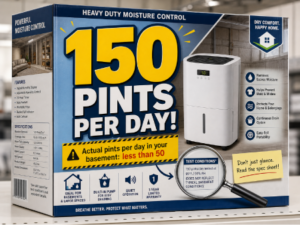
One commonly sold portable unit advertises moisture removal of 150 pints per day. But its own spec sheet shows that rating is achieved at extreme testing conditions of 95°F and 90% relative humidity.
Under cooler, more realistic conditions, the numbers drop fast:
| Test Condition | Portable “150-Pint” Unit Capacity |
| 95°F / 90% RH | 150 pints per day |
| 86°F / 80% RH | 116.8 pints per day |
| 80°F / 60% RH | 75.4 pints per day |
| 65°F / 60% RH | 49.67 pints per day |
That means the “150-pint” unit removes less than 50 pints per day under 65°F / 60% RH conditions. The unit is not useless. It just is not the same machine that the advertising on its packaging makes it sound like.
That is the difference between a box rating and basement reality.
How an AprilAire E-series Compares
AprilAire’s claims for ‘pints per day (ppd)” are much more authentic of real-world applications and adhere to the new 2020 guidelines set by the DOE.
For example, the AprilAire E130 is rated at:
| Test Condition | AprilAire E130 Capacity |
| 80°F / 60% RH | 130 pints per day |
| 73°F / 60% RH | 105 pints per day |
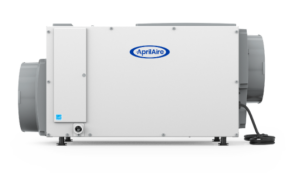
AprilAire lists the E130 for whole-home dehumidification and moisture control in areas like basements and crawl spaces. Its spec sheet also lists a washable MERV 8 filter, corrosion-resistant aluminum coils, a ¾-inch threaded drain connection, and a 5-year warranty.
Now compare the AprilAire E130 against that “150-pint” portable unit under the same 80°F / 60% RH testing condition:
| Unit | Capacity at 80°F / 60% RH |
| Portable unit advertised as 150 PPD | 75.4 pints per day |
| AprilAire E130 | 130 pints per day |
Under the same listed conditions, the AprilAire E130 removes about 72% more moisture than the portable unit.
That is the part many homeowners never see. The portable unit may win on sticker price, but the AprilAire wins the apples-to-apples capacity comparison.
What About Energy Use?
Capacity is only part of the story. Energy efficiency matters too, especially during humid Wisconsin weather when a dehumidifier may run for long stretches.
The portable unit example lists an Integrated Energy Factor, or IEF, of 2.01 L/kWh. The AprilAire E130 lists 2.9 L/kWh at 80°F / 60% RH and 2.35 L/kWh at 73°F / 60% RH. In plain English, the AprilAire removes more moisture for the electricity it uses.
Using the published energy factors, the AprilAire E130 removes about 44% more moisture per kilowatt-hour than the portable unit at the 80°F / 60% RH rating.
So the better question is not just, “Which unit is cheaper to buy?”, it’s “Which unit removes more moisture, more consistently & more efficiently?”
What Does This Mean for Your Wallet?
The AprilAire E130 is not just stronger, it’s more efficient per pint of water removed. Based on published energy factors and Wisconsin electricity rates of roughly 17 to 18.5 cents per kWh, the E130 costs about $2.77 to $3.02 to remove 100 pints of water. A commonly sold portable “150-pint” unit costs about $4.00 to $4.36 to remove that same amount.
That may only add up to about $50 in seasonal electricity savings for many homes, so energy savings alone are not the whole story. The bigger difference is that the E130 removes more moisture faster, requires less runtime to do the same work, drains automatically, and is designed as a longer-term humidity-control solution.
Additionally, the AprilAire has an estimated lifespan of 15 years. At today’s rates, that is about $750 in estimated energy savings over 15 years. If electricity costs continue rising 2% to 5% per year, that lifetime savings could grow roughly $865 to $1,080 over the expected life of an AprilAire dehumidifier.
Clearing Up One Common Misconception About Whole-Home Dehumidifiers
A whole-home dehumidifier does not have to be connected directly to your HVAC ductwork to be a real whole-home solution. In many Wisconsin homes, the better strategy is to control humidity where the problem usually starts: the basement.
Basements and crawlspaces are cooler, damper, and more prone to musty odors & high humidity than the main living space. If that area is feeding moisture into the home, it often makes sense to control humidity where the problem begins before it can cause problems elsewhere.
A dedicated basement installation is not a downgrade. In many cases, it allows the dehumidifier to work closer to the source of the moisture instead of relying on existing ductwork, airflow patterns, or HVAC runtime to do the job. An Indoor Air Quality expert from Kettle Moraine Heating can help you determine which installation method is best for treating high humidity in your unique home.
When a Portable Dehumidifier Makes Sense
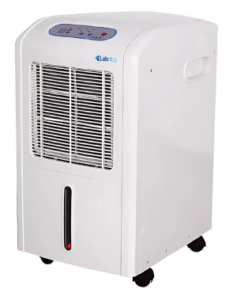 Portable dehumidifiers are not all bad. They can be a smart choice when:
- You only need to dry one room
- The moisture problem is temporary
- You’re working with a tighter budget
- You do not mind emptying a bucket
- You have a nearby drain for hose drainage
- You’re not worried about a shorter lifespan
- You’re not concerned about short warranty coverage
- You are not trying to control humidity across a larger area
For light-duty situations, a portable unit may be plenty.
The problem is when homeowners expect a portable unit to behave like a permanent, whole-home, moisture-control system.
The EPA recommends keeping indoor humidity below 60%, ideally between 30% and 50%, when possible. That is not just about comfort. Better humidity control can also help reduce conditions that allow moisture-related issues to develop.
One important note: a dehumidifier is not a fix for active water intrusion. If water is leaking into your basement, that issue should be addressed first. But once the source of water is controlled, a dehumidifier can help manage the moisture left in the air.
The Bottom Line
A portable dehumidifier can be a good short-term or single-room solution. But the advertised pint rating does not always tell the full story.
A unit marketed as “150 pints per day” may only reach that number under extreme hot and humid test conditions. In cooler, more realistic basement conditions, that same unit may remove far less moisture.
AprilAire E-series dehumidifiers are built for higher-capacity, longer-term moisture control. And in many Wisconsin homes, installing it as a dedicated basement or stand-alone system is not a compromise. It may be the better way to control humidity where the problem starts.
So before choosing a dehumidifier, do not just ask: “Which one has the biggest number on the box?” Ask: “Which one will actually control humidity in my home?”
If your basement always feels damp, smells musty, or keeps winning the annual “why does it feel like a cave down here?” contest, we can help you decide whether a portable unit is enough or whether a professionally installed whole-home dehumidifier is the best solution.
Read more blog posts from Kettle Moraine Heating & AC.
About the Author
Josh Walejewski
Josh is a professional marketer who has worked in the HVAC industry since 2017. With a Bachelor of Applied Arts and Sciences Degree (B.A.A.S) in marketing and sustainable business management from the University of Wisconsin, he has a passion for all aspects of HVAC, business, marketing, and environmental stewardship.