

August 2026
By: Josh Walejewski
Read Time: 1-2 Minutes
When Wisconsin temperatures climb into the upper 90s or reach triple digits, you may notice your air conditioner running almost nonstop.
Your thermostat might be set to 72°, but the house stubbornly hangs around 75° or 76°.
Does that automatically mean something is wrong? Not necessarily.
Understanding how air conditioners are sized can help explain why even a properly working system may struggle during extreme heat. We’ll look at what your AC was designed to handle, how to help it keep up, and which warning signs suggest it is time to call for service.
Your AC Is Designed for Wisconsin, Not Death Valley
Air conditioners are sized around local summer “design conditions.” In plain English, your system is selected to handle the normal peak summer conditions where you live.
It is not sized around the hottest temperature Wisconsin could ever throw at us.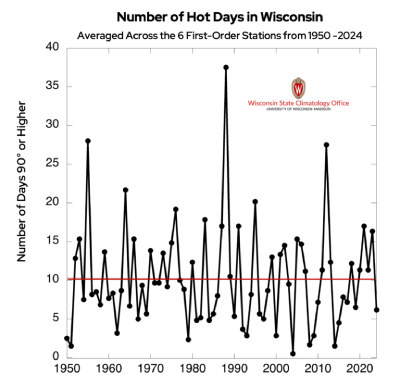
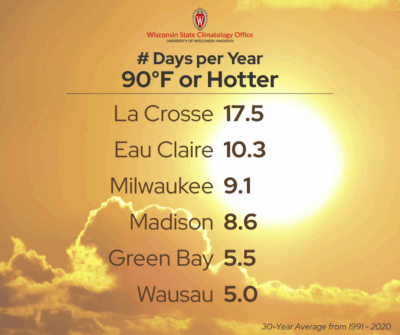
While it may seem surprising, Wisconsin averages only about 10 days per year when temperatures reach 90°F or higher. Perhaps even more surprising, that statewide yearly average has remained relatively consistent since 1950.
When outdoor temperatures push into the upper 90s or approach triple digits, your AC may be operating near or beyond the conditions it was sized around. It may run continuously and still fall a few degrees behind, especially if:
- Your thermostat is set in the low 70s or cooler
- Afternoon sun hits large windows
- Exterior doors are frequently opened
- Your air filter is dirty
- Your home has limited insulation or air sealing
Continuous operation during extreme heat does not automatically mean your AC is failing. In many cases, it means the system is working exactly how it’s designed. It may simply be removing heat almost as quickly as new heat is entering your home. Causing it to work longer and harder to do it’s job.
Heatwave Tip: Give Your AC a Head Start
Before the outdoor temperature peaks, try pre-cooling your home by a few degrees.
For example, if you normally keep your thermostat at 74°, lower it to 70° during the cooler morning hours. Then, before the afternoon heat arrives, close blinds on sun-facing windows and avoid generating unnecessary heat indoors.
Think of it like giving your AC a running start instead of asking it to catch up after your home is already hot.
My home’s AC is getting up there in age, so I sometimes worry about overworking the old girl. One personal rule that has treated me well over the years is trying not to let the difference between my thermostat setting and the outdoor temperature grow much beyond 20 degrees.
For example, if it reaches 95° outside, I may bump my thermostat from my preferred 70° up to around 74° or 75°. That 20-to-25-degree range is not a hard rule every homeowner or air conditioner must follow, but it gives my older system a more realistic target and reduced workload during the hottest part of the day.
The basic strategy is to get a head start during the cooler morning hours, then ease up on your expectations once the afternoon heat arrives.
When Should You Call for Service?
A few degrees of temperature drift during extreme heat may be normal. However, you should consider having the system checked if:
- The AC is blowing warm air
- The indoor temperature continues climbing after sunset
- Some rooms suddenly feel much warmer than others
- The system repeatedly turns on and off
- You notice unusual noises, odors, ice or water
Extreme heat can expose existing problems. Other times, your AC is simply working as hard as it can against unusually difficult conditions. If you notice any of the symptoms listed above, our team is here to help.
Read more blog posts from Kettle Moraine Heating & AC.
About the Author
Josh Walejewski
Josh is a professional marketer who has worked in the HVAC industry since 2017. With a Bachelor of Applied Arts and Sciences Degree (B.A.A.S) in marketing and sustainable business management from the University of Wisconsin, he has a passion for all aspects of HVAC, business, marketing, and environmental stewardship.